

Most sellers think pricing is something you can adjust later. Start high, see what happens, come down if you need to. It feels like the safe play — you can always lower the price, but you can't raise it.
The problem is that the market doesn't work on your schedule. By the time you've decided to come down, the moment that mattered has already passed.
The First Two Weeks Decide Almost Everything
When your home hits the market, it goes out to every buyer who has been watching that price range, that neighborhood, that style of house. Some of them have been looking for months. Their agents have alerts set. They see your listing within hours.
That's the largest and most motivated audience your home will ever have, and you get it exactly once.
If the price makes sense to those buyers, you get showings. If several of them show up, you may get competing offers — which is the only reliable way a sale price goes above asking. If the price doesn't make sense, they scroll past. And they don't come back next month to check whether you've reconsidered.
After that first wave, you're working with whoever wanders into the market week by week. It's a much smaller pool. That's why a home priced correctly on day one often sells faster and higher than the same home priced 5% above and reduced a month later.
You're not pricing to attract a buyer eventually. You're pricing to attract the buyers who are already looking, right now.

What Actually Sets Your Price
A listing price isn't a number you pick. It's a read on four things.
Recent comparable sales. What similar homes nearby actually closed for — not what they listed for, and not what a neighbor says they got. Closed sales in the last 60 to 90 days, adjusted for real differences in size, condition, and location.
Condition relative to those comps. If the comparable homes had updated kitchens and yours hasn't been touched since 2004, that gap has a dollar value. So does a new roof, a level lot, or a primary bedroom on the main floor.
What you're competing against right now. Comps tell you what buyers paid. Active listings tell you what else those buyers can choose instead. If four similar homes are sitting unsold in your neighborhood, that matters more than a strong sale from last spring.
Timing. Spring and early summer bring more buyers to the Portland market, but they also bring more competition. A well-priced home in a quieter month can outperform a mispriced one in a busy one.
An honest pricing conversation covers all four. If someone hands you a number without walking through them, ask why.
What Overpricing Actually Costs
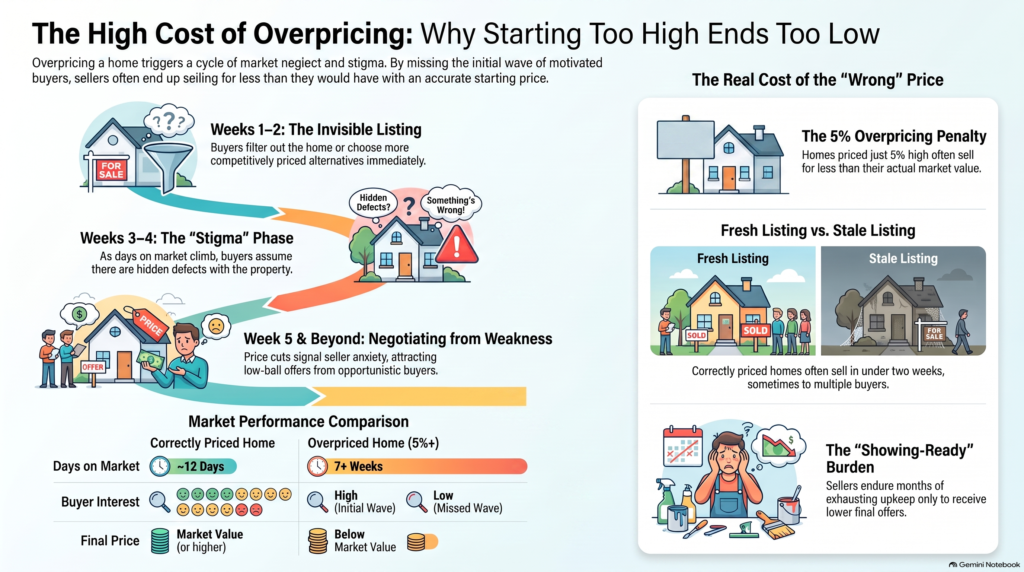
Here's the part sellers underestimate: overpricing doesn't just delay the sale. It usually lowers the final number.
The sequence is predictable.
Weeks one and two — no traffic. The buyers who would have loved your home never came to see it, because it was filtered out of their search or looked expensive next to the alternatives.
Weeks three and four — the listing goes quiet. Days on market starts climbing. Anyone who does look now sees a listing that's been sitting and starts wondering what's wrong with it. Nothing may be wrong with it. That's not how it reads.
Week five or six — the first reduction. You cut the price. But you're no longer showing to that original wave of buyers; they're gone. And a reduction sends its own signal: this seller has been waiting, and may be getting anxious.
Week seven and beyond — offers come in below where you'd have landed. Now you're negotiating from a weaker position, against buyers who can see exactly how long you've been on the market and how far you've already come down.
That's the real cost. Not just the extra weeks of keeping the house showing-ready, though that's genuinely exhausting. It's that a home priced 5% high often sells for less than it would have at the right number — after months of additional effort.
Meanwhile the correctly priced home two streets over sold in twelve days, possibly to more than one interested buyer.
What the Portland Data Shows
Nearly half the single-family listings in Multnomah County have taken a price reduction. The chart below updates weekly, so you can see where it stands today — but the trend matters more than any single number. Reductions bottomed near 35% in February and have climbed steadily through spring and summer as inventory built and buyers got more selective.
% of Multnomah County single-family listings with a price reduction. Source: Altos Research, updated weekly.
When that share is this high, it means a large portion of sellers priced above what the market would bear and had to correct. Every one of those reductions represents a seller who spent weeks discovering something the market would have told them on day one.
A chart is easy to nod at and hard to feel. So here's the version that matters. On a $600,000 home, the difference between pricing right and correcting your way down is often 2 to 4% of the final number — real money — plus another six to ten weeks in a house you're trying to leave.
Pricing Is Different When You're Downsizing
When you need the proceeds of your current home to fund your next purchase, you are a contingent buyer. See "How to Make a Contingent Offer Sellers Will Accept" for more details.
An over-market price home that sits for three months doesn't just cost you time — it can cost you the home you want to move into. Inventory in the one-level and smaller-home segment tends to move quickly, and the house you toured in April will likely go pending before July. That changes the calculation in a few ways.
Certainty is worth something real. A price that produces offers in the first two weeks gives you a known closing date, and that's what makes a contingent offer credible to the seller on the other end.
A stale listing weakens your buying position too. Sellers of your next home will look at your listing history. A home that's been sitting ninety days with two reductions doesn't inspire confidence that you'll close.
Emotional pricing is the most expensive kind. After twenty-five or thirty years in a house, it's natural to price it for what it's worth to you. I've been through this myself — I sold the home my family lived in for twenty-five years. The memories are real. They aren't in the comps.
The goal isn't to underprice. It's to price where the market actually is, so the sale happens on a timeline that lets you move into you next home with a minimum of stress.
Before You Pick a Number
A few questions worth asking, whoever you work with:
- What did comparable homes close for in the last 60 to 90 days — not list for?
- What am I competing against on the market right now?
- What's the realistic window in which I should expect showings and offers?
- If we haven't seen activity in two weeks, what's the plan?
That last one matters most. A pricing strategy without a checkpoint isn't a strategy — it's a hope.
And pricing is only the first of three negotiations in a home sale. The repair addendum and the appraisal are still ahead of you, and both of them are easier when your price was grounded in real numbers from the start.
If you'd like a straight read on what your Portland-area home would realistically sell for right now, I'm glad to walk through it with you. No pressure, no obligation, and no interest in telling you a number you want to hear if the market says otherwise.